View-Independent Methods for Photorealistic Real-Time Multi-View Ray Tracing
2026-05-22
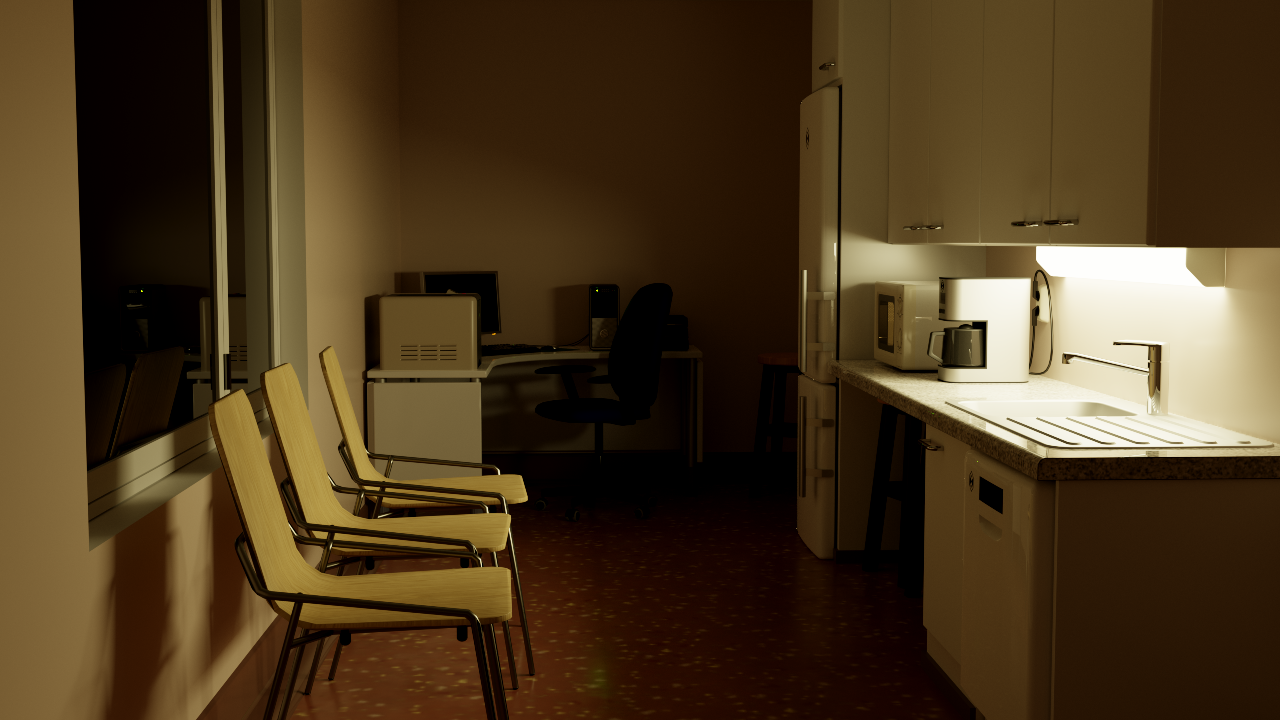
Abstract: Many data structures commonly used in real-time computer graphics are tied to pixels or viewpoints. Such methods are called “screen-space” due to operating in screen coordinates. Such structures only provide information of surfaces that are directly visible to the camera. This is a problem for ray tracing, which is used by physically based rendering methods like path tracing, where rays of light may end up beyond what’s visible on the screen. Such structures also present scaling difficulties on multi-view displays, such as head-mounted displays, as their memory and performance requirements grow with additional viewpoints and pixels.
This dissertation proposes several world-space data structures as improvements over screen-space equivalents. Such structures no longer store information per-pixel or per-view, but instead contain a structure that covers the entire 3D scene and is defined in world coordinates. New data structures are proposed for indirect lighting and for culling lights and decals. Additionally, an improvement to a common antialiasing method is presented. This improvement suppresses erroneous trails left by moving objects, which are known as “ghosting”. Together, these data structures and algorithmic improvements enable using ordinary consumer graphics hardware to render real-time path traced visuals for virtual reality devices.